
Stair lifts aren’t a realistic option for everyone, but wheelchair users and those who use walkers often wonder whether they can use their mobility devices at home. While it’s a fair question, the answer is more nuanced.
The short version: most stair lift users with walkers or wheelchairs can absolutely use one. The key is understanding what happens at the top and bottom of the stairs, and planning for it. Here’s everything you need to know about using a stair lift when also using a walker or wheelchair.
Quick Overview
- Stair lifts are designed for people who can sit, ride, and stand with some assistance
- You can carry walkers on the lift or keep them at each landing
- Wheelchair users typically transfer to the stair lift seat and have a second chair waiting upstairs
- The landing setup at the top and bottom of your staircase matters more than most people realize
Walker Users and Stair Lifts
Those with a walker or rollator can typically use stair lifts with minimal fuss. The stair lift takes over the job the walker can’t do: getting you between floors safely.
The practical question is what to do with the walker during the ride. There are a few approaches that can work well:
- Keep a walker on each floor. This is the simplest solution and removes the need to carry the walker on the stair lift. While this costs more upfront, it greatly reduces the burden on your daily routine.
- Opt for a lightweight folding walker that’s easy to carry as you ride on the stair lift. You can carry it across your lap or hook it on an armrest. Foldable models work best for this, as normal models are too bulky to carry on the lift.
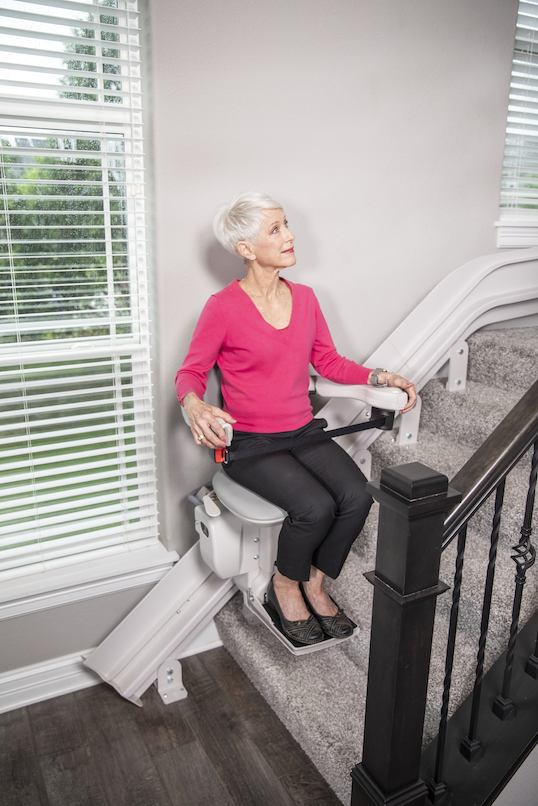
Transferring at each landing is what you’ll need to think through. A power swivel seat rotates the chair toward the landing before you stand, so you don’t have to twist to get up. For walker users who need a stable surface to push up from, this feature is worth the extra cost.
Wheelchair Users and Stair Lifts
Stair lifts are different from wheelchair lifts or vertical platform lifts (VPLs). A standard stair lift seat is designed for a person who can transfer from a wheelchair, sit in the seat, ride between floors, and transfer back to a wheelchair at the top floor.
Transferring is the critical point. If you can do a seated transfer on your own or with assistance, a stair lift is the most affordable option (over a home elevator or platform lift). If you can’t transfer on your own, then other mobility devices will work best for you.
Wheelchair users who can use a stair lift need to consider the setup at each landing. There should be enough space to position the wheelchair next to the stair lift seat for a side transfer. This is something a technician will assess during a free in-home visit, and it’s not something to leave to guesswork.
What the Landing Setup Looks Like
Whether you use a walker or a wheelchair, the usability of a stair lift depends on the landing conditions at the top and bottom of the stairs.
At the bottom landing, there needs to be enough floor space to get in and out of the seat without bumping into walls, doors, or furniture. In older homes in Harrisburg, Lancaster, Reading, and York, where the staircase opens directly into a tight entry hall, this can be a real constraint.
At the top landing, the same principle applies. If the stair lift seat swivels toward the landing and you need to transfer to a wheelchair, there must be clearance for the wheelchair to pull alongside.
None of this is necessarily a dealbreaker, but it’s information that needs to be on the table before you purchase.
Other Mobility Equipment to Know About
If a stair lift turns out not to be the right fit for your situation, it’s worth knowing what the alternatives are:
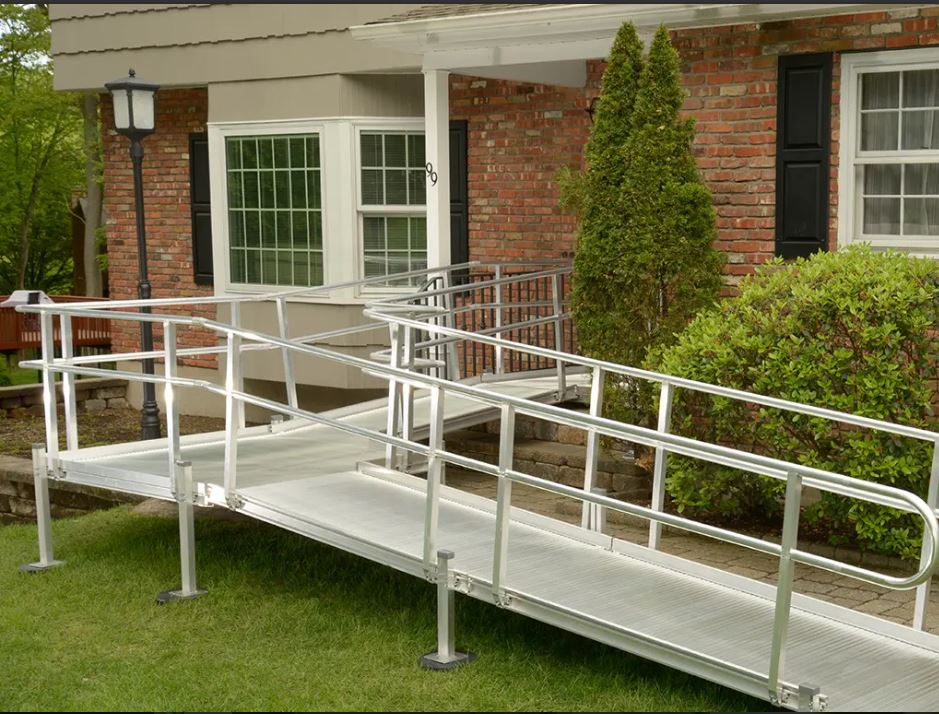
Vertical platform lifts work like a small elevator. A wheelchair rolls directly onto the platform, and the platform travels up or down. These require more space and more significant installation work, but eliminate the transfer requirement entirely.
Stair-climbing wheelchairs exist as a product category, though they’re not a common household solution and typically require a trained attendant.
Residential elevators are the most comprehensive solution for full wheelchair access between floors, but the cost and installation scope are considerably higher than those of a stair lift.
FAQ: Stair Lifts With Walkers and Wheelchairs
Can I bring my walker on the stair lift?
Yes, you can carry a lightweight folding walker on a stair lift. Larger wheelchairs would be difficult to carry on a stair lift and shouldn’t be moved between floors.
What if I can’t stand up from the stair lift seat on my own?
If you can’t stand on your own, you likely won’t be able to use a stair lift with a wheelchair or walker. Explore other options such as a home elevator or vertical platform lift.
Do I need a second wheelchair upstairs?
Yes, you can place a wheelchair on each floor so it’s easily accessible. It makes it even easier to get up and down on the stair lift.
Is there a weight limit I should know about?
Yes, standard stair lifts can carry up to 300 pounds, and bariatric models between 400 and 600 pounds and have wider seats.
Who can I call to talk about my situation in Pennsylvania?
Call Independent Home Solutions at 717-393-8213. Our service areas in Pennsylvania include Harrisburg, Lancaster, Reading, and York.